
heyuoqing@gmail.com
86-18988729072
In the injection molding process, mold temperature directly influences the appearance, dimensional accuracy, internal stress, and production cycle of the plastic parts. Excessive or fluctuating mold temperatures can easily lead to defects such as shrinkage, air bubbles, deformation, sticking to the mold, and uneven surface textures. An industrial chiller paired with an injection molding machine provides a continuous supply of cooling water at a constant temperature to the mold, removing the heat released by the molten plastic. By enabling precise temperature control of the mold, these chillers serve as an indispensable cooling solution for injection molding production lines.
I. Core Refrigeration Cycle Principle of Injection Molding Chillers
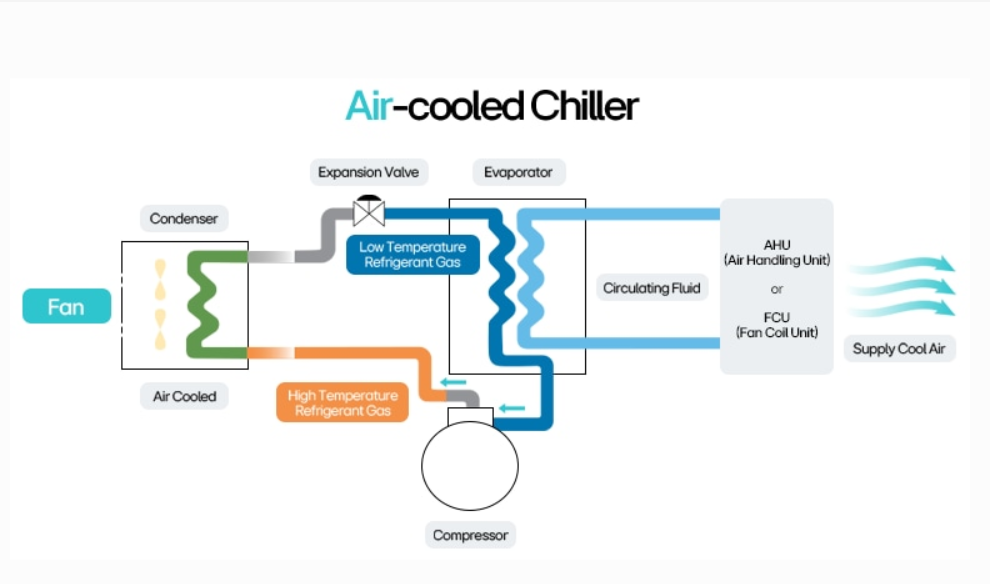
Industrial chillers for injection molding operate based on a vapor-compression refrigeration cycle. The system consists of four primary components:
a compressor, a condenser, a throttling device (capillary tube or expansion valve), and an evaporator. Refrigerant circulates through a closed-loop piping system,
undergoing continuous phase changes to facilitate heat transfer:
Compression: The compressor draws in low-temperature, low-pressure gaseous refrigerant and compresses it into a high-temperature, high-pressure gas,
effectively storing heat within the refrigerant.
Condensation: The high-temperature, high-pressure refrigerant enters the condenser. In air-cooled models, a fan circulates air to remove heat; in water-cooled models,
a cooling tower circulates water to dissipate heat. As the refrigerant cools, it condenses into a high-pressure liquid.
Throttling and Pressure Reduction: The liquid refrigerant passes through an expansion valve or capillary tube, causing a sharp drop in both pressure and temperature,
resulting in a low-temperature, low-pressure gas-liquid mixture.
Evaporation and Heat Absorption: The low-temperature refrigerant enters the evaporator, where it exchanges heat with the circulating water in the water tank. It absorbs
heat from the water, cooling it down to the target set temperature. Having absorbed heat, the refrigerant returns to a gaseous state and flows back to the compressor, beginning the cycle anew.
II. Heat Exchange Process Between Chilled Water and Injection Molds
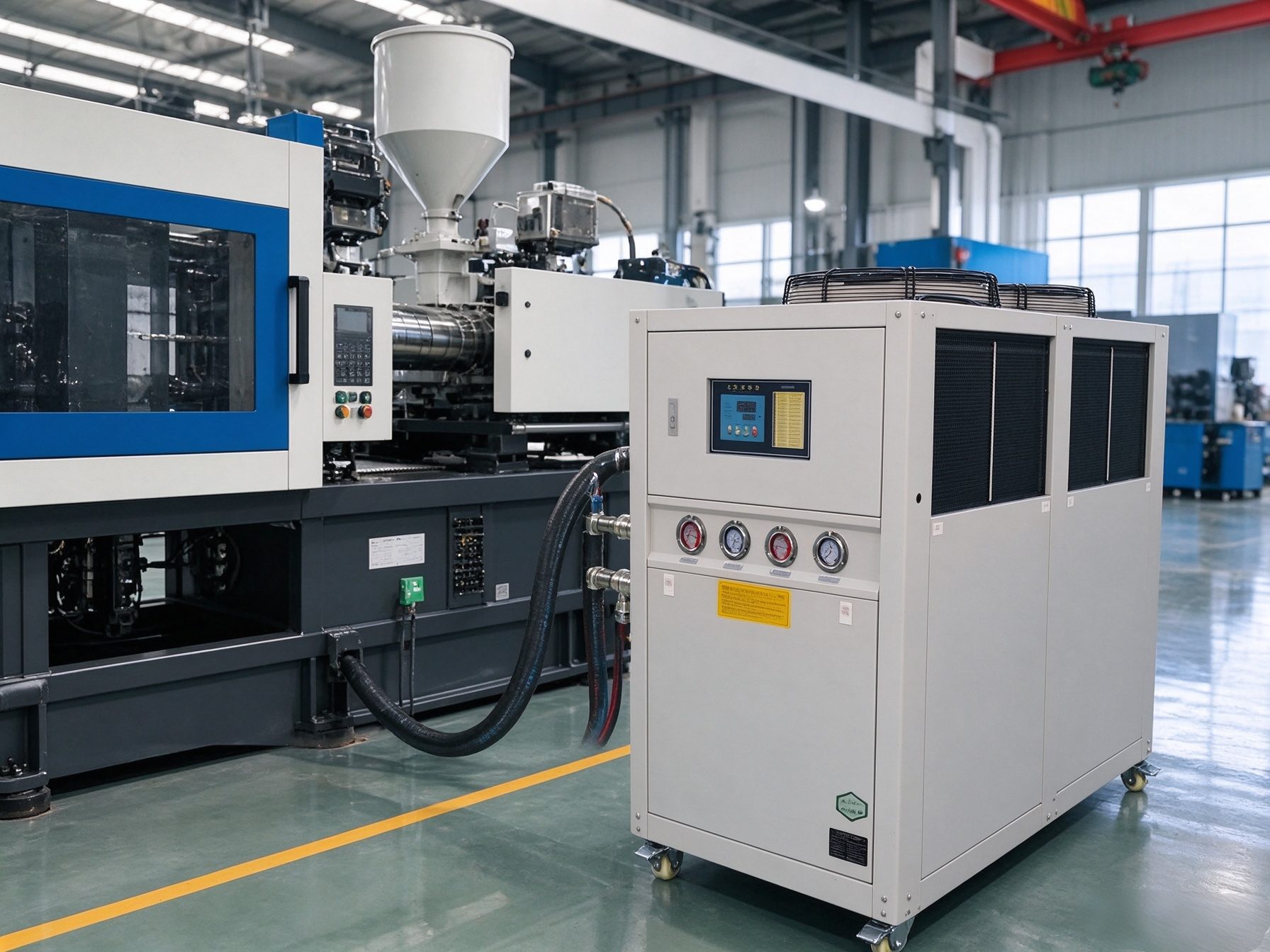
Once the chiller has prepared chilled water at a constant temperature, a pump pressurizes the fluid and delivers it through insulated piping into the
cooling channels within the injection mold:
The cold water flows through the mold’s cooling circuits, continuously absorbing heat from the mold and maintaining its temperature within the
range specified by the production process.
After absorbing heat and rising in temperature, the water returns to the chiller’s evaporator tank, where it is cooled once again by the refrigerant,
creating a continuous cycle.
The unit is equipped with an intelligent temperature controller that monitors the inlet and outlet water temperatures in real time, automatically
managing start/stop cycles and load adjustments to prevent significant temperature fluctuations.
✅ Key Distinction: A Chiller is NOT a Mold Temperature Controller. A mold temperature controller is primarily used to heat the mold and maintain it at a high, constant temperature. In contrast,
a chiller is designed for low-temperature cooling, typically providing an adjustable outlet water temperature range of 5–25°C—ideal for the cooling and solidification of most plastics, such as PP, ABS, PC, and nylon.
III. Choosing Between Air-Cooled and Water-Cooled Chillers for Injection Molding
Two main types of chillers are commonly used in the injection molding industry:
Air-cooled chillers feature built-in cooling fans. They are easy to install—requiring no external cooling tower—and can be put into operation simply by connecting water and power. They are ideal for facilities with limited space, small-to-medium-sized injection molding plants, or production lines that may need to be relocated frequently.
Water-cooled chillers utilize an external cooling tower for heat dissipation. They offer higher cooling efficiency and more stable operation, making them the preferred choice for high-capacity units (30 HP and above). They are well-suited for large-scale injection molding facilities or projects where cooling is centralized for multiple injection molding machines.
Available in capacities ranging from 1 HP to 100 HP, these units can be selected based on factors such as the tonnage of the injection molding machine, mold size, type of plastic raw material, and production capacity.
IV. Benefits of Stable Chilled-Water Cooling for Injection Molding Facilities
Maintains a constant mold temperature, significantly reducing defect rates related to product deformation, warpage, shrinkage, and silver streaks;
Shortens cooling cycles, accelerates the injection molding machine’s operating rhythm, and increases output per unit of time;
Improves product dimensional consistency, thereby lowering costs associated with reworking defective parts;
Protects the injection molding machine’s hydraulic system and oil circuits, preventing excessive oil temperatures that would otherwise accelerate the aging of seals.
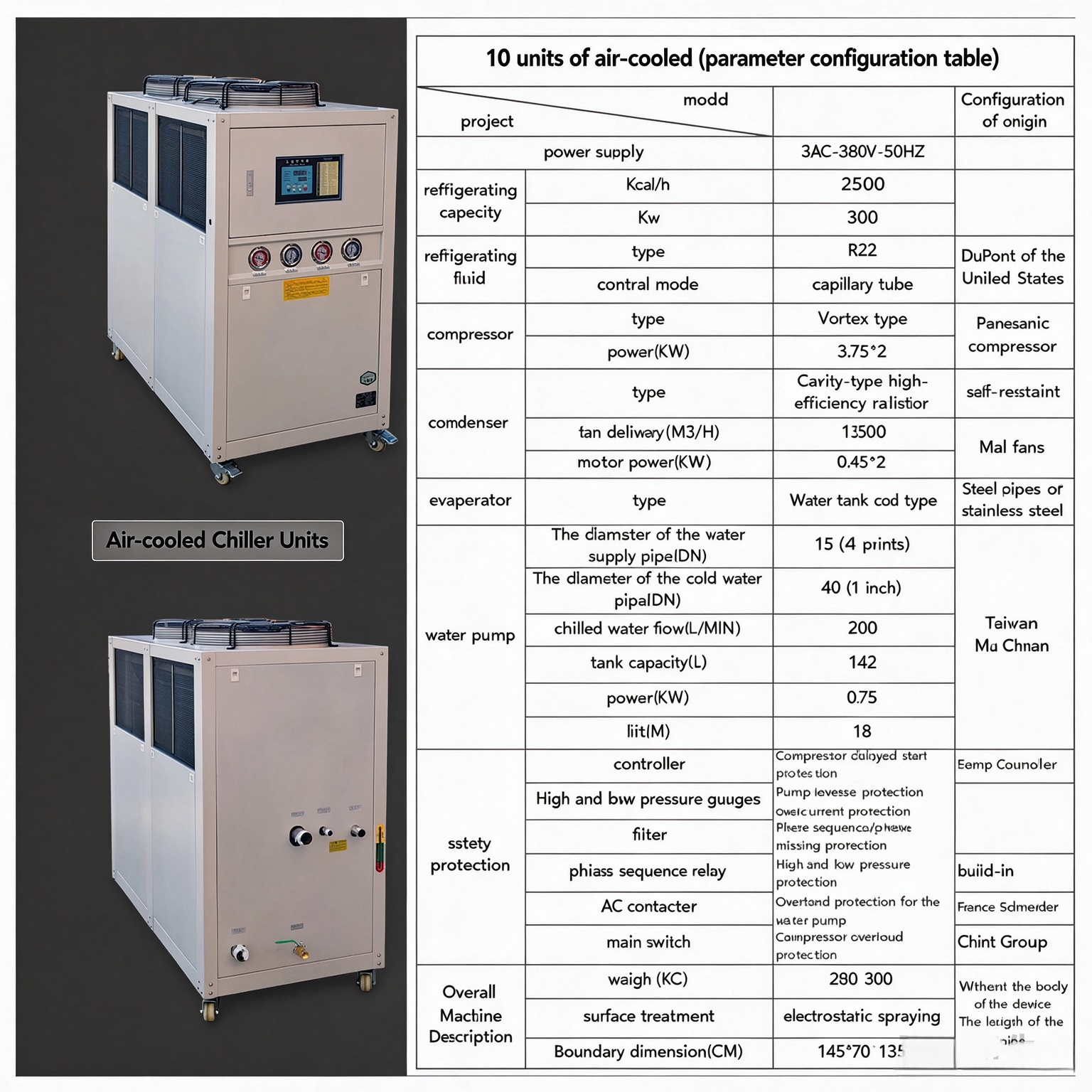
Recommended: Jianlong (Shenzhen) Industrial Chiller (3).png
V. Tips for Daily Use
1. Regularly clean the condenser and filter to prevent blockages caused by dust or scale, which can reduce cooling efficiency.
2. In environments with poor water quality, it is recommended to install a water softening system to minimize scale buildup in mold cooling channels and the evaporator.
3. Set an appropriate water outlet temperature based on your specific plastic molding process; avoid aiming for excessively low temperatures, as this can lead to condensand unnecessary energy waste.
Jianlong (Shenzhen) Industrial Co., Ltd. specializes in the production of 1–100 HP chillers for the injection molding industry. We offer both air-cooled and water-cooled
models, support customization, and provide solutions tailored to various plastic molding processes.
Contact: Kelly
WhatsApp: +8618988729072
Official Website: https://www.machinejianl.com/
Contact: kelly
Phone: 18988729072
Tel: 86-18988729072
Email: heyuoqing@gmail.com
Add: Guangyi Industrial Park, No. 2, Tanglip Jinfu West Road, Liaobu Town, Dongguan City, China
We chat